This time, it's in Geneva. I am not particularly impressed with the Inter-religious dialogue efforts to date. I suppose some conference invitees are thrilled with it because they get to press hands with heads-of-state, eat sumptuous food, and enjoy royal gifts. However, last year's conference ended on a sour note when the organizers tried to issue a final statement without approval of the attendees.
The authorized guidelines for the entire effort were settled at the June, 2008 Islamic Preparatory Conference on Religious Dialogue - the "Makkah initiative" referred to in the article. Among other things, these can be read as directing Muslim delegates to proselytize and not listen to others, and if they do listen to protect against "demoralization". link
Were these guidelines meant for real, or are they just pieces of paper necessary to pursue a genuine effort? In my opinion, this is the point where the Dialogue stalls.
Will taking the Dialogue to the grassroots by help it break through this barrier? Or will deeper roots will add to the intellectual inertia that prevents Dialogue from going forward. I think the latter is the case - and Abdullah Al-Turki, chief organizer of these conferences as head of the Muslim World League, knows this.
Thursday, October 01, 2009


Tuesday, September 29, 2009
On the Goldstone Report
This massive 574-page report, originally commissioned by the (deeply-flawed) United Nations Human Rights Council (UNHRC) to explore exclusively Israeli wrongdoing (by design, taking Israel's actions out-of-context) and later pushed to its limits by its chief investigator, Richard Goldstone, to include some of the actions of Hamas and the Palestinians who Israel was actually fighting, seems to upset Jews mightily. Perhaps it shouldn't.
Do people ever considered that the U.N.'s first priority may be to protect its own personnel, including locally-hired Arabs? (Originally set up mostly to help Jews after WWII, the United Nations Relief Works Agency is now exclusively devoted to Arab relief and most of its staff are Palestinians.)
If you were running the UN, what would you do under the circumstances? How are you supposed to protect your employees in Arab refugee camps without U.N. police and troops which the Security Council won't supply? Especially in a Gaza where Arabs claim that Hamas throws those who oppose it from roof-tops?
Might you not choose to issue reports exculpating those who threaten your employees, even as you try to document their crimes in the hope that they could one day in the future be brought to justice? Bray loudly in agreement with tormentors as you whisper for help to others?
Would Hamas have threatened the UNRWA about teaching the Holocaust if Hamas didn't feel that terrorizing the U.N. wasn't effective? Indeed, the UNRWA assured Hamas they would do no such thing.
Consider that the Goldstone Report contains the confession that Hamas leaders employed human shields, but adds that confession is not proof. This shield the U.N. from retribution – not that the U.N. bothered to look very hard at such proofs.
There’s lots of other silliness in there, but some good stuff in between the lines. For the Goldstone Report is a "non-judicial" document, hence labeling the confessions of Hamas leaders as "boasts" won't matter a bit if these matters are taken to criminal court; the Report serves as evidence, not judgment.
One must also consider what’s missing that an unafraid investigator would have reported. The one thing one can’t do is take the report at face value – especially its allegations against Israel.
Rather than condemn the document entirely, I would focus on its contextual and factual aspects - real facts that can be confirmed, not dreamed-up fantasies and distortions - and express sympathy for the U.N. and all Arab populations that have to live under the thumb of crippling dictators; if the Arabs truly want credibility to their rants, it won't be through U.N. reports, but by accepting the need for freer societies and freedom of debate within their own communities.
Do people ever considered that the U.N.'s first priority may be to protect its own personnel, including locally-hired Arabs? (Originally set up mostly to help Jews after WWII, the United Nations Relief Works Agency is now exclusively devoted to Arab relief and most of its staff are Palestinians.)
If you were running the UN, what would you do under the circumstances? How are you supposed to protect your employees in Arab refugee camps without U.N. police and troops which the Security Council won't supply? Especially in a Gaza where Arabs claim that Hamas throws those who oppose it from roof-tops?
Might you not choose to issue reports exculpating those who threaten your employees, even as you try to document their crimes in the hope that they could one day in the future be brought to justice? Bray loudly in agreement with tormentors as you whisper for help to others?
Would Hamas have threatened the UNRWA about teaching the Holocaust if Hamas didn't feel that terrorizing the U.N. wasn't effective? Indeed, the UNRWA assured Hamas they would do no such thing.
Consider that the Goldstone Report contains the confession that Hamas leaders employed human shields, but adds that confession is not proof. This shield the U.N. from retribution – not that the U.N. bothered to look very hard at such proofs.
There’s lots of other silliness in there, but some good stuff in between the lines. For the Goldstone Report is a "non-judicial" document, hence labeling the confessions of Hamas leaders as "boasts" won't matter a bit if these matters are taken to criminal court; the Report serves as evidence, not judgment.
One must also consider what’s missing that an unafraid investigator would have reported. The one thing one can’t do is take the report at face value – especially its allegations against Israel.
Rather than condemn the document entirely, I would focus on its contextual and factual aspects - real facts that can be confirmed, not dreamed-up fantasies and distortions - and express sympathy for the U.N. and all Arab populations that have to live under the thumb of crippling dictators; if the Arabs truly want credibility to their rants, it won't be through U.N. reports, but by accepting the need for freer societies and freedom of debate within their own communities.
Wednesday, September 02, 2009
Remembering the Hebron Massacre
By JEROLD S. AUERBACH link
No theme is more deeply embedded in Jewish history than exile and return. The biblical exodus from Egypt to the promised land, the return from Babylonian exile, and, most recently, the establishment of the state of Israel all affirmed the enduring determination of the Jewish people to return to their homeland.
Yet another wrenching exile and return, now rarely remembered, occurred 80 years ago this week. On Aug. 23-24, 1929, the Jewish community of Hebron was exiled following a horrific pogrom. The tragedy is known as Tarpat, an acronym for its date in the Hebrew calendar.
Until 1929, Jews had lived in Hebron for three millennia. There, according to Jewish tradition, Abraham purchased the cave of Machpelah to bury Sarah. It was the first parcel of land owned by the Jewish people in their promised land. Ever since, religious Jews revered Hebron as the burial site of their matriarchs and patriarchs. Conquered, massacred and expelled over the centuries, Jews always returned to this sacred place.
After 1267, under Muslim rule, no Jews were permitted to pray inside the magnificent enclosure, built by King Herod in the 1st century, that still surrounds the burial caves. But following the expulsion of Jews from Spain at the end of the 15th century, a small group of religious Jews rebuilt a community of study and prayer in Hebron.
In August 1929, that community was suddenly and brutally attacked. Incited by the Grand Mufti of Jerusalem—who claimed that Jews were endangering Muslim holy sites on the Temple Mount in Jerusalem—Arab rioters swept through Palestine. In Hebron, the carnage was horrendous.
It began on Friday afternoon when Arabs attacked Jews with clubs and murdered a yeshiva student. The next morning, joined by local villagers, Arabs swarmed through Hebron screaming "Kill the Jews." They broke into the home of Eliezer Dan Slonim, where many Jews had gathered for safety. There they wielded knives and axes to murder 22 innocents. In the Anglo-Palestine Bank, where 23 corpses were discovered, blood covered the tile floor. That day, three children under the age of five were murdered. Teenage girls, their mothers and grandmothers were raped and killed. Rabbis and their students were castrated before they were slain. A surviving yeshiva student recounted that he "had seen greater horrors than Dante in hell."
When the slaughter finally subsided, 67 Jews had been murdered. Three days later, British soldiers evacuated 484 survivors, including 153 children, to Jerusalem. The butchery in Hebron, Zionist and religious officials alleged, was "without equal in the history of the country since the destruction of the Temple." Sir Walter Shaw, chairman of an exhaustive British royal investigation, concluded that "unspeakable atrocities" had occurred.
Tarpat extinguished the most ancient Jewish community in Palestine. With synagogues destroyed, Jewish property converted into storerooms and barns for livestock, and the ancient cemetery desecrated, few signs remained that there had ever been a Jewish presence in Hebron.
But nearly 40 years later, after the Six-Day War of 1967, a small group of religious Zionists returned to Hebron to rebuild the destroyed community. "What was in the past in Hebron," declared their matriarch Miriam Levinger, "is what will happen in the future. Always!" So it would be.
The Jewish community of Hebron—some 700 people—recently celebrated the 40th anniversary of their return. This month they commemorate the 80th anniversary of Tarpat. All the other ancient peoples mentioned in the Bible have vanished. But Jews, a community of memory, still live in Hebron.
Hebron Jews are relentlessly vilified as fanatics who illegally occupy someone else's land. As religious Zionists, they are the militant Jewish settlers whom legions of Jewish and non-Jewish critics love to hate. It is seldom noticed that their most serious transgression—settlement in the biblical land of Israel—is the definition of Zionism: the return of Jews to their historic homeland.
Mr. Auerbach, a professor of history at Wellesley College, is the author of "Hebron Jews: Memory and Conflict in the Land of Israel," published in July by Roman & Littlefield.
***
On the other hand, Arabs like Bu Jassem refer to such reporting as "a complete joke by western media to be so biased against the Palestinians." link. His recommendation is that people "think not" of the Hebron massacre, but instead of "the murderous campaigns of Israel".
Would Israel even have to exist as a separate Jewish State if events like the Hebron Massacre hadn't demonstrated the failure of Arabs to stand for justice within their communities, so that if Jews were to live in their internationally-endorsed homeland, they would have to fight to establish justice themselves? And is this not similar to the struggles other minority population in the middle east have today?
Elder of Zion, Ian, Anna Baltzer, and bataween continue the discussion.
No theme is more deeply embedded in Jewish history than exile and return. The biblical exodus from Egypt to the promised land, the return from Babylonian exile, and, most recently, the establishment of the state of Israel all affirmed the enduring determination of the Jewish people to return to their homeland.
Yet another wrenching exile and return, now rarely remembered, occurred 80 years ago this week. On Aug. 23-24, 1929, the Jewish community of Hebron was exiled following a horrific pogrom. The tragedy is known as Tarpat, an acronym for its date in the Hebrew calendar.
Until 1929, Jews had lived in Hebron for three millennia. There, according to Jewish tradition, Abraham purchased the cave of Machpelah to bury Sarah. It was the first parcel of land owned by the Jewish people in their promised land. Ever since, religious Jews revered Hebron as the burial site of their matriarchs and patriarchs. Conquered, massacred and expelled over the centuries, Jews always returned to this sacred place.
After 1267, under Muslim rule, no Jews were permitted to pray inside the magnificent enclosure, built by King Herod in the 1st century, that still surrounds the burial caves. But following the expulsion of Jews from Spain at the end of the 15th century, a small group of religious Jews rebuilt a community of study and prayer in Hebron.
In August 1929, that community was suddenly and brutally attacked. Incited by the Grand Mufti of Jerusalem—who claimed that Jews were endangering Muslim holy sites on the Temple Mount in Jerusalem—Arab rioters swept through Palestine. In Hebron, the carnage was horrendous.
It began on Friday afternoon when Arabs attacked Jews with clubs and murdered a yeshiva student. The next morning, joined by local villagers, Arabs swarmed through Hebron screaming "Kill the Jews." They broke into the home of Eliezer Dan Slonim, where many Jews had gathered for safety. There they wielded knives and axes to murder 22 innocents. In the Anglo-Palestine Bank, where 23 corpses were discovered, blood covered the tile floor. That day, three children under the age of five were murdered. Teenage girls, their mothers and grandmothers were raped and killed. Rabbis and their students were castrated before they were slain. A surviving yeshiva student recounted that he "had seen greater horrors than Dante in hell."
When the slaughter finally subsided, 67 Jews had been murdered. Three days later, British soldiers evacuated 484 survivors, including 153 children, to Jerusalem. The butchery in Hebron, Zionist and religious officials alleged, was "without equal in the history of the country since the destruction of the Temple." Sir Walter Shaw, chairman of an exhaustive British royal investigation, concluded that "unspeakable atrocities" had occurred.
Tarpat extinguished the most ancient Jewish community in Palestine. With synagogues destroyed, Jewish property converted into storerooms and barns for livestock, and the ancient cemetery desecrated, few signs remained that there had ever been a Jewish presence in Hebron.
But nearly 40 years later, after the Six-Day War of 1967, a small group of religious Zionists returned to Hebron to rebuild the destroyed community. "What was in the past in Hebron," declared their matriarch Miriam Levinger, "is what will happen in the future. Always!" So it would be.
The Jewish community of Hebron—some 700 people—recently celebrated the 40th anniversary of their return. This month they commemorate the 80th anniversary of Tarpat. All the other ancient peoples mentioned in the Bible have vanished. But Jews, a community of memory, still live in Hebron.
Hebron Jews are relentlessly vilified as fanatics who illegally occupy someone else's land. As religious Zionists, they are the militant Jewish settlers whom legions of Jewish and non-Jewish critics love to hate. It is seldom noticed that their most serious transgression—settlement in the biblical land of Israel—is the definition of Zionism: the return of Jews to their historic homeland.
Mr. Auerbach, a professor of history at Wellesley College, is the author of "Hebron Jews: Memory and Conflict in the Land of Israel," published in July by Roman & Littlefield.
***
On the other hand, Arabs like Bu Jassem refer to such reporting as "a complete joke by western media to be so biased against the Palestinians." link. His recommendation is that people "think not" of the Hebron massacre, but instead of "the murderous campaigns of Israel".
Would Israel even have to exist as a separate Jewish State if events like the Hebron Massacre hadn't demonstrated the failure of Arabs to stand for justice within their communities, so that if Jews were to live in their internationally-endorsed homeland, they would have to fight to establish justice themselves? And is this not similar to the struggles other minority population in the middle east have today?
Elder of Zion, Ian, Anna Baltzer, and bataween continue the discussion.
Friday, July 31, 2009
Mission Accomplished?
As the U.S. withdraws from an active role in Iraqi affairs to military bases and then home, Iraqi leaders step up to the plate. Here's one story told by a U.S. soldier of a ceremony to re-open a bridge  crossing an open sewer dividing Sunni and Shia communities, an event made possible only because Americans slogged it out hard with blood and spent treasure heavily for five years to reduce sectarian conflict:
Because we've given the Iraqis more than they can ever hope to repay, they must take the attitude that they owe us nothing at all - that it was the Americans who brought terror to their country and gave nothing in return.
Very much like the French who complained there was no fighting in Normandy until the Americans landed. Remember, the first speech DeGaulle gave after the Allied liberation of Paris was to give all credit to the French for the liberation. Not one word about British and American forces - and no word about collaborators, either.
Five years ago I wrote:
But all we got was an Iraq that doesn't tolerate terrorists, and that may change. The Iraqis now have a republic of sorts - if they can keep it. I sense we are leaving without the values of democracy rooted in the government - the people don't feel empowered, as the Americans did with their (mildly) corrupt state governments after the Revolutionary War.
crossing an open sewer dividing Sunni and Shia communities, an event made possible only because Americans slogged it out hard with blood and spent treasure heavily for five years to reduce sectarian conflict:In the 120 degree heat, we listened to readings from the Quoran, poetry from local civilians, and speeches from top generals. They talked about the great things the Iraqi Army has done and the secure future that is in store for the Iraqi people. Everyone felt good about themselves; you could feel it in the air.
As we stood to move to the ribbon cutting and bridge crossing there was an announcement. A couple of the religious leaders wanted to make statements. Everyone obliged and returned to their seats.
Sunni and Shia both stood and made the same claims. My translator began to speak, “A day of brotherhood, unity, and security. There was to be only one people; Iraqi Muslims. No more Sunni, no more Shia…..”
My translator stopped speaking.
“What are they saying?” I asked.
“You don’t want to know.”
“Tell me.”
“Okay, sir. Coalition Forces and Terrorists are no long welcome in this country.” my translator stated.

Because we've given the Iraqis more than they can ever hope to repay, they must take the attitude that they owe us nothing at all - that it was the Americans who brought terror to their country and gave nothing in return.
Very much like the French who complained there was no fighting in Normandy until the Americans landed. Remember, the first speech DeGaulle gave after the Allied liberation of Paris was to give all credit to the French for the liberation. Not one word about British and American forces - and no word about collaborators, either.
Five years ago I wrote:
We Americans put too much faith in gratitude. The fond feeling the French had for us twice saving them faded in the 1960's. The Germans want to forget their debts to us for freedom and unification... Both want - desperately - to believe the U.S. today is just as bad as they were in their imperial days -- to lessen their collective feelings of guilt and moral inferiority, and to justify their refusal to stand side-by-side with the United States...Gratitude goes even less far in the Arab world. Arabs today have, at best, selective memories; at worst, they believe their own lies, and, by the noise of repetition, impress it into others...
...the Iraqis must feel that they created their own democracy, not one imposed by an "empire"...In the end, they may feel angry with us, but if they succeed, they will be a real, confident, country, one that will stand up for democratic values, like El Salvador is today -- not wilted lettuces like France and Germany. We want an Iraq that won't tolerate terrorists in its midst." link
But all we got was an Iraq that doesn't tolerate terrorists, and that may change. The Iraqis now have a republic of sorts - if they can keep it. I sense we are leaving without the values of democracy rooted in the government - the people don't feel empowered, as the Americans did with their (mildly) corrupt state governments after the Revolutionary War.
Friday, July 03, 2009
Pakistan's War
Since April, the tide of Pakistani opinion has turned:
"The Pakistani media had lost both its fear and its illusions about extremists, who had once been portrayed as ‘Robin Hood’ figures" link
In contrast with earlier operations, the Pakistani Army is working very aggressively. link The turning point in Pakistani public opinion was the widely-circulated video of a teenage girl in Swat being punished for khulwa, being seen by a man not her family. Pakistanis decided that such punishment wasn't what they wanted.
True to form, the Taliban's leaders have resorted to increasingly brutal and intimidating methods to maintain their rule over their forces and their captive population:
Unfortunately the government's success in winning over the populace by the technique of letting the Talibs show how bad they can be rather than fighting the Talibs in the first place means they can continue to be corrupt, rather than face popular pressure to reduce corruption and improve governance.
Luckily, some newspapers realize that: Practical Democracy
Even as the Taliban find themselves caught between the American hammer and the Pakistani forge, even as Pakistan and the U.S. now share a common enemy, Pakistanis themselves do not see the U.S. as a friend link. I consider this a sure measure of the failure of America's current Public Diplomacy efforts - cooperation is quiet, rather than overt and celebrated. Even under Obama, Pakistanis still feel that the goal of the U.S. president is "to impose American culture on the Islamic world, and 90 percent supported the notion that he wanted to weaken and divide the Muslim world". In IDP camps the Americans are told to work quietly, while Islamists preach jihad openly - as a condition for refugees to receive their aid. (Reminds me of the folks who tried to sell me a time-share during my honeymoon in exchange for a lift.)
I wonder what the next generation of Pakistanis will think - both of their elders and of the U.S.
"The Pakistani media had lost both its fear and its illusions about extremists, who had once been portrayed as ‘Robin Hood’ figures" link
In contrast with earlier operations, the Pakistani Army is working very aggressively. link The turning point in Pakistani public opinion was the widely-circulated video of a teenage girl in Swat being punished for khulwa, being seen by a man not her family. Pakistanis decided that such punishment wasn't what they wanted.
True to form, the Taliban's leaders have resorted to increasingly brutal and intimidating methods to maintain their rule over their forces and their captive population:
Baitullah Mehsud ordered 18 of his wounded men slaughtered before retreating in the face of the army operation going on against him. The men lost their lives because they were no longer fit to keep up with the rest as they made good their escape. Seeing the operation unfolding effectively against the TTP, the parents of the boys he had shanghaied into his suicide-bomber training camps begged him to release their offspring. He refused. Baitullah is showing signs of being under pressure by employing savage tactics of retaliation too. Anyone who speaks against him inside the vast tracts occupied by the various warlords is liable to get killed. As he moves from one safe place to another safe place to avoid being hit by the Pakistan jets, he is carefully monitoring his rivals within the Taliban and eliminating them.
Unfortunately the government's success in winning over the populace by the technique of letting the Talibs show how bad they can be rather than fighting the Talibs in the first place means they can continue to be corrupt, rather than face popular pressure to reduce corruption and improve governance.
Luckily, some newspapers realize that: Practical Democracy
Even as the Taliban find themselves caught between the American hammer and the Pakistani forge, even as Pakistan and the U.S. now share a common enemy, Pakistanis themselves do not see the U.S. as a friend link. I consider this a sure measure of the failure of America's current Public Diplomacy efforts - cooperation is quiet, rather than overt and celebrated. Even under Obama, Pakistanis still feel that the goal of the U.S. president is "to impose American culture on the Islamic world, and 90 percent supported the notion that he wanted to weaken and divide the Muslim world". In IDP camps the Americans are told to work quietly, while Islamists preach jihad openly - as a condition for refugees to receive their aid. (Reminds me of the folks who tried to sell me a time-share during my honeymoon in exchange for a lift.)
I wonder what the next generation of Pakistanis will think - both of their elders and of the U.S.
Sunday, June 21, 2009
Iran's Second Revolution, Week Two

I grab a broken brick and throw. I’m amazed. I never thought I’d do it. I should practice. It was a very bad shot. I grab another one, the size of a pomegranate and keep it with me, hiding it behind my back. My feeling is a mixture of a university teacher and a hooligan -
...There is a woman who is being beaten. She’s horrified and hysterical but not as much as the anti-riot police officer facing her. She shrieks, ‘Where can I go? You tell me go down the street and you beat me. Then you come up from the other side and beat me again. Where can I go?’
In sheer desperation, the officer hits his helmet several times hard with his baton. ‘Damn me! Damn me! What the hell do I know!’
How much longer can this go on?
Thursday, June 18, 2009
The Mouse Roars!
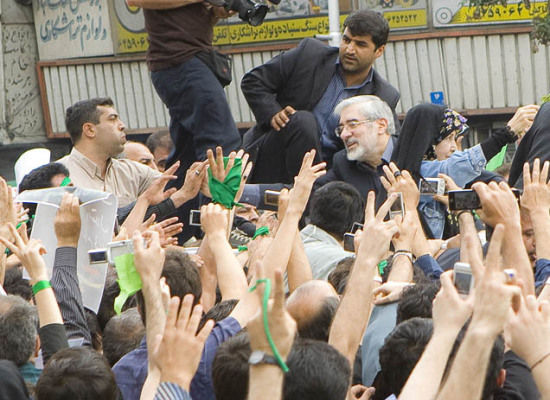
· I have come due to concerns of current political and social conditions - to defend the rights of the nation
· I have come to improve Iran's International relations
· I have come to tell the world and return to Iran our pride, our dignity, our future
· I have come to bring to Iran a FUTURE of FREEDOM, of HOPE, of fulfilment
· I have come to represent the poor the helpless the hungry
· I have come to be ACCOUNTABLE to you my people and to this world
· Iran must participate in FAIR elections, it is a matter of national importance
· I have come to you because of the corruption in Iran
· 25% inflation means IGNORANCE - THIEVING - CORRUPTION - where is the wealth of my nation?
· What have you done with $300 BILLION in last 4 years - where is the wealth of the nation?
· The next Gov of Iran will be chosen by the people
· Why do all our young want to leave this country?
· I know of no creation who places HIMSELF ahead of 20 million of the nation
· We are Muslims - what is happening in Iran Government is a sin.
· This Gov is not what Imam Khomeini wanted for Iran - #Iranelection I will change all this - This is the SEA of GREEN
It sounds promising, but that last line worries me. The Mouse and his allies (Rafsanjani, Khatami, etc.) demonstrably know how to deflect and defuse popular sentiment for their own ends, and the last time they did that they helped Khomeini eliminate all political opposition to create the mullahocracy that so many Iranians despise. What will they do different now?
Note that the regime's thugs are now beginning to cover their faces. It is important that when the crowd catches one of them that they are photographed and even fingerprinted (one can always cut open a pen) before being released. Fear of accountability will then spread quickly through their ranks.
Iran Election Twitter feeds
[Posting comments over at Contentions.]
Update, 6/19/09: Supreme Leader Ayatollah Khamenei threw down the glove this morning and declared the vote legitimate, as a worried-looking Mahmoud Ahmedenejad, a man who knows he is currently president only in name, looks on. It seems no more compromises are possible, The Mouse must either accept the results or work outside the system and choose revolution.
 Mehdi Jami writes:
“This is the end of Khamenei and the beginning of a new era. He doesn’t hear our voice and doesn’t speak our language…today, Khamenei showed the people that he is not their leader…He sees us as enemies. Elections are not important for him. He only represents a small group of people. The problem is that he wants to suppress other groups so they cannot participate in decision-making. People feel this. They see that power is in the hands of a few. Khamenei even dislikes the old leaders of the revolution. In this regime, there’s no place for anyone with a different opinion.
Khamenei resigned from real leadership and was demoted to the leadership of a certain group of his supporters. He easily ignored and threatened this great opposition, which according to his own formal statistics, is composed of 13 million people. His problem is that he wants to ignore the population. His biggest mistake was to say that he is closer to the current president than to the people. According to our constitution, our leader cannot belong to one political party or another. He will be remembered as a leader who split the people, ended his own leadership and became a tribal chief. He created divisions in the society.
Khamenei says there are legal ways to protest. But in such a system, which laws are legitimate? A law on paper is not a law. A law together with its administrators is a law. When the administrators are corrupt, create roadblocks to the implementation of the law and interpret it any way they want, how can one have any hope in the role of law? Based on which law has he arrested hundreds of people? Based on which law has he ignored the complaints of millions of people?
I am certain that opposition by the great people of Iran will continue against this kind of politics and leadership until they find a new leader who is able to think of the people and does not dominate a small group over the larger population.
Mousavi and Karroubi are leaders of an opposition that did not vote for Ahmadinejadism. This is a result of Khamenei’s mistake who has tied his future with Ahmadinejad. This is a great movement by millions. Either Mousavi or Karroubi realize this and take the responsibility to lead it or they will retreat because of threats. But it is clear that this great power [opposition] will not remain without a leader and will not die down. Khamenei’s era is over and new leaders are compelled to emerge.
What goes through the minds of today's young revolutionaries?
“I will participate in the demonstrations tomorrow. Maybe they will turn violent. Maybe I will be one of the people who is going to get killed. I’m listening to all my favorite music. I even want to dance to a few songs. I always wanted to have very narrow eyebrows. Yes, maybe I will go to the salon before I go tomorrow! There are a few great movie scenes that I also have to see. I should drop by the library, too. It’s worth to read the poems of Forough and Shamloo again. All family pictures have to be reviewed, too. I have to call my friends as well to say goodbye. All I have are two bookshelves which I told my family who should receive them. I’m two units away from getting my bachelors degree but who cares about that. My mind is very chaotic. I wrote these random sentences for the next generation so they know we were not just emotional and under peer pressure. So they know that we did everything we could to create a better future for them. So they know that our ancestors surrendered to Arabs and Mongols but did not surrender to despotism. This note is dedicated to tomorrow’s children…”
Revolution, yes, but even now it is not certain that the rule of mullahs will be overthrown, for The Mouse represents conservative yet inclusive influences, not liberal Western ones.
The best hope for Iranians today is that the men on both sides are professional revolutionaries - they did this in 1979, remember - so that, like good generals, they will know when to tell their troops to retreat or surrender. This revolution could still be less bloody than the last. Tomorrow may be critical.
In the meantime, Iranians are enjoying a brand-new sport: Basiji hunting.
Subscribe to:
Posts (Atom)