http://www.dawn.com/2011/11/24/no-kosher-way-to-annihilate.html
"Thou shall not kill" is NOT "Jews' "most sacred covenant". The commandment is "Thou shall not murder". We Jews are not forbidden the right to kill in self-defense nor the right to slaughter animals for food.
"Thou shall not murder" is a commandment not to commit slaughter your fellow man out of hatred for him. This the Israelis have certainly followed admirably compared to other nations. Not only is the murder and crime rate in Israel's orthodox communities close to zero, Israel's example - too often distorted into the opposite by the media - of acting against aggression yet NOT wontonly engaging in the mass slaughter of peoples whose leaders have vowed eternal enmity towards them has been emulated by other nations, specifically the United States and, lately, the Pakistani Army itself. Isn't that something the citizens of Swat and Wazirstan have to be thankful for?
Pakistanis suffer from many problems. Among them is this: having driven out every Jewish voice from the country, some Pakistanis have been tempted to invent their own interpretations of Jewish Law as a means of ridiculing and demeaning Jews or Israelis. It appears Jawed Naqvi is one of these.
Furthermore, I find it hard to believe that he is acting out of ignorance of Jews, given the close association he cites with them in India and elsewhere (though he may have been misled by dishonest intellectuals like Chomsky); rather, isn't it most likely he is trying to mislead Pakistanis, including himself? After all, I'm not the only one to note that Pakistani intellectuals deal with large amounts of cognitive dissonance every day. Yet that is no excuse for leading his countrymen down the road of aggressive war and damnation, is it?
Respectfully yours,
- Solomon2
http://solomon2.blogspot.com
[emailed to Dawn and Mr. Naqvi]
Thursday, November 24, 2011


Tuesday, November 15, 2011
Responding to the USS Liberty calumny
"During the 1967 War with Egypt and Syria, the Israeli Air Force knowingly bombed the USS Liberty — an American surveillance ship — and blamed it on the Egyptians." link
The Liberty, operating just outside Egyptian waters, was indeed attacked by Israeli warplanes. It was a "fog of war" mistake:
The Liberty was not far away when an ammo dump on shore suddenly exploded - thought to be by a bombardment from ship. Although identified earlier as an American warship, the Israelis did not maintain contact - they were looking for Egyptian warships and subs - and the Israelis thought, talking to the U.S. naval attache, that the Liberty was gone from the area; however, these orders had been mis-routed. The Liberty remained offshore but after the explosion proceeded (by unhappy coincidence, having reached the eastern end of its patrol area) towards Egyptian waters at high speed, and was then mis-identified as an enemy vessel fleeing the scene of an attack.
These facts are available from both U.S. and Israeli official sources and U.S. documentation. [Ref: Michael Oren, Six Days of War] I hope all readers note that very few, if any, Pakistani, Muslim, or Arab writers exerted themselves in the slightest fashion to unearth the true story, as best as it is known.
Over and over even "liberal"-minded Pakistanis miss the truth about Israel and its actions, preferring to wallow in demonisation instead. How many realize that the mind-set necessary to do this is EXACTLY the mind-set that invents reasons to bomb mosques and rape and kill innocents in their own country? The same mind-set that gives the O.K. to corruption rather than good government? I guess such thoughts, too horrible to evaluate, simply vanish on contact - and so Pakistan's terrible decay continues and its citizens continue to sink into a vast moral morass.
The Arab writer, Abdulateef al-Muhim, formerly a Saudi naval commodore, has often wondered how history would have been different had the Arabs recognized Israel in 1948 instead of vowing to eliminate the country and exterminate its Jewish population.link So do I: perhaps there might never have been a Saudi-supported Pakistani curriculum promoting the distortion of fact and fraud on an ummah-wide level. Muslims would have realized that by supporting extermination-minded Muslims against Jews that they are supporting criminality, not justice. Can Pakistanis gather the strength to change their own nature?
***
The Express Tribune refused to publish the comment.
UPDATE 11/21/11: My comment was published, after all.
The Liberty, operating just outside Egyptian waters, was indeed attacked by Israeli warplanes. It was a "fog of war" mistake:
The Liberty was not far away when an ammo dump on shore suddenly exploded - thought to be by a bombardment from ship. Although identified earlier as an American warship, the Israelis did not maintain contact - they were looking for Egyptian warships and subs - and the Israelis thought, talking to the U.S. naval attache, that the Liberty was gone from the area; however, these orders had been mis-routed. The Liberty remained offshore but after the explosion proceeded (by unhappy coincidence, having reached the eastern end of its patrol area) towards Egyptian waters at high speed, and was then mis-identified as an enemy vessel fleeing the scene of an attack.
These facts are available from both U.S. and Israeli official sources and U.S. documentation. [Ref: Michael Oren, Six Days of War] I hope all readers note that very few, if any, Pakistani, Muslim, or Arab writers exerted themselves in the slightest fashion to unearth the true story, as best as it is known.
Over and over even "liberal"-minded Pakistanis miss the truth about Israel and its actions, preferring to wallow in demonisation instead. How many realize that the mind-set necessary to do this is EXACTLY the mind-set that invents reasons to bomb mosques and rape and kill innocents in their own country? The same mind-set that gives the O.K. to corruption rather than good government? I guess such thoughts, too horrible to evaluate, simply vanish on contact - and so Pakistan's terrible decay continues and its citizens continue to sink into a vast moral morass.
The Arab writer, Abdulateef al-Muhim, formerly a Saudi naval commodore, has often wondered how history would have been different had the Arabs recognized Israel in 1948 instead of vowing to eliminate the country and exterminate its Jewish population.link So do I: perhaps there might never have been a Saudi-supported Pakistani curriculum promoting the distortion of fact and fraud on an ummah-wide level. Muslims would have realized that by supporting extermination-minded Muslims against Jews that they are supporting criminality, not justice. Can Pakistanis gather the strength to change their own nature?
***
The Express Tribune refused to publish the comment.
UPDATE 11/21/11: My comment was published, after all.
Saturday, October 15, 2011
Book Review: Pakistan: A Hard Country

Ever since late 2008 I've spent most of my "Solomon2" time over at the Pakistani Defence Forum. I've also done a lot of reading on Pakistan. However, one exchange revealed I didn't that there are no jury trials in Pakistan.
Jury trials are the very intersection of society and the institutionalized process of justice. Since I didn't know there were no jury trials, I concluded that I was missing something very basic: while I had studied Pakistan's military and the decision-making process of its policymakers and such knowledge might be of some utility, my knowledge of Pakistani society was not.
Back to the books, then! The most-recent comprehensive view of Pakistan is the 500-page Pakistan: a Hard Country by Anatoly Lieven - an experienced British author who is also a senior fellow at the New America Foundation, an outfit that has invited me to several mid-east and Pakistan-related events, for reasons unknown.
 Both Lieven and Zbigniew Brzezinski are scions of European aristocrats displaced by the Bolsheviks; while the experience drove Brzezinski to help support an insurgency in Afghanistan in the 1970s, Lieven's heritage seems to have compelled him to investigate the current result of such impetuosity. The author has toured Pakistan extensively twice, twenty years apart. This has helped him distinguish long-term attitudes from spur-of-the-moment popular trends, and taught him to be cautious at evaluating Pakistani public opinion.
On the minus side, Lieven makes several unsupported cuts against Israel - possibly his admission ticket to a Pakistan where, as one interlocutor once told me, "Pakistanis say they can't be openly pro-Israel because their throats could be slit twenty minutes later." Or maybe his anti-Israel attitude is honestly felt, expressing the current bias of Britain's intellectual class.
Succos plus Shabbat being a three-day holiday my reading plans were set. In between family time, prayer time, community time, and by stealing some hours from sleep I accomplished my purpose, for the book is a real eye-opener.
First, nothing else I've read so far comes close to depicting Pakistani society in breadth with illustrative episodes of detail.
Second, it strongly suggests that my conception of Pakistan was fundamentally wrong. I had thought that of Pakistan as a strong state dominated by a military lording it over society. Instead, Lieven depicts a weak state dominated by multiple strong societies within. Many a time the military finds it more effective to solve problems - even deadly ones - by negotiation, realizing that killing off kin-leaders can be counterproductive to building a successful Pakistan.
So Pakistan isn't really a mini-Roman Empire on the verge of coming apart. It's been in pieces since the beginning. Within the weak state the military is dominant but it only serves as a kind of glue holding fissiparous kin-groupings and ethnicities together. Not an empire decaying into feudalism but a feudal collective existing under the state - not particularly happily, as many are convinced life was better under previous princely rulers than under today's irresponsible bureaucrats and ministers.
(This again suggests to me that seeking a presidential- or parliamentary-type system in Afghanistan and Pakistan has been a mistake; constitutional monarchies with free cities would have been better. Monarchs at least own responsibility for their actions. Elected officials can usually obfuscate matters to hide their own involvement, something easy to do when the populace is mostly illiterate and there are no good checks and balances.)
Third, Pakistanis are corrupt, and this corruption is both personal and collective. Any Pakistani who has any power at all, even a tiny amount, uses it to improperly manipulate the state to his or his kin-group's advantage. If an individual commits a crime the courts often fail to convict because he can instantly enlist ten family members (even distant cousins) to provide alibis for him. Swearing on the Koran is not allowed: Since it is assumed that all witnesses lie doing so would discredit Islam, which is forbidden. With corruption the rule, politics and crime (closely related in Pakistan) are reduced to power-sharing negotiations between different parties: the "negotiated state" as Lieven puts it. The most effective law enforcement measures are "encounter killings" - extrajudicial executions of murderous miscreants, usually at night.
Fourth, about juries: Jury trials were forbidden in British India as incompatible with the colonial system and Pakistan and India both kept this after independence. At PDF both Indians and Pakistanis approved this: "We had it many decades ago but it was done away with as being unsuitable to our socio-economic environment" "We are different doesn’t mean we are evil and lesser beings"
(While Colonial America did have jury trials the Americans had greater experience with self-government and a higher literacy rate. One should also remember that the Vice-Admiralty courts of the late Colonial period, set up to enforce trade laws, had no juries - and were very much hated by Americans.)
Fifth, confirmation that, as I had gathered from my readings and on-line conversations, Pakistanis are greatly afflicted by self-deception usually expressed in but not limited to conspiracy theories. The problem is as wide-spread as I imagined, permeating all classes, and in the intellectual class going right up to the level of university president. The amazing and upsetting part is that such unsupported (and unsupportable) pronouncements are taken as more authoritative than pronouncements backed up by serious research. The author writes that the conspiracy-theory mentality is bred by the Army itself.
Sixth, the dacoits. This was a surprise. I had no idea that the Pakistani elite still employed professional robber-killers on retainer. I had thought this a thing of the past.
Seventh, the media. As I had strongly suspected from the moderation of my comments on Pakistani newspaper sites, the media can be very strongly influenced by the military. "The change in media coverage was crucial to the change in Pakistani public opinion" regarding operations in Swat. Such success naturally makes me wonder how much more could be done, should the military put its will into it.
Eighth, it isn't all about Islam. There is also the code of the Pathan, pashtunwali, and for women in particular that is much worse. Reading this, I realized that when President Bush criticized the Taliban for its treatment of women a few years back he was not criticizing sharia law, as I thought at the time, but pashtunwali. If I made this mistake then I suppose other Americans have done the same.
Additional conclusions thus far:
1) Pakistani police need to be better-paid, need better training and access to forensic equipment, and a greater division between local and national outfits; currently they are not tools of security as much as traffic cops or political tools to employ against rivals.
2) I have a somewhat more sympathetic attitude towards the Pakistani military than I did before, but only slightly. The P.A.'s moral judgments lead to much suffering among Pakistan's neighbors. Its nuclear weapons whet militant appetites and disorder. And its domestic meddling has kept society together but also kept many problems from being solved and allowed others to fester. The word that comes to my mind is embrittlement.
Tuesday, September 13, 2011

Tuesday, September 06, 2011
Daily Times: Abnormality syndrome in Pakistan — I
As a teenager, when I was supposed to be enjoying life, making friends, watching movies, playing games, socialising and talking about our little dreams, I was thinking of pleasing God and hating His perceived enemies
“The only abnormality is the incapacity to love” — Anais Nin.
According to Wikipedia, “Abnormality, in the vivid sense of something deviating from the normal or differing from the typical (such as an aberration), is a subjectively defined behavioural characteristic, assigned to those with rare or dysfunctional conditions.”
Some might call me judgmental, others label me as cynical and delusional while some associate me with a class that thinks nothing can go right in Pakistan but still fails to understand what actually is wrong with this country. To understand this abnormality, I have reflected on my own life here — a journey where I was growing up in a religiously conservative and culturally oppressive society.
I recall how Hindus and Jews were my sworn enemies, even though I had not seen any. Christians were there to work as sweepers and cleaners and we were told not to shake hands with them or take any food from them, thus making me believe, as a child, that all Christians were sweepers and dirty. I did not know of Ahmedis and Barelvis but I was told that they were not good people either. Shias were not Muslims; once a student asked our Islamic studies teacher why a section of the Islamic studies book was titled ‘for Shia students only’ for which he was beaten mercilessly because he did not know the difference between a ‘Musalmaan’ (Muslim) and ‘kaafir’ (non-believer) as taught by that teacher in my school.
All that I saw and experienced was religion and hatred. It felt like we were bowels that were constantly being filled with hatred. I was growing up with a negative and twisted personality like millions of others are today. I did not know how to love but I surely knew how to hate: to hate anyone who is not Muslim. As a teenager, when I was supposed to be enjoying life, making friends, watching movies, playing games, socialising and talking about our little dreams, I was thinking of pleasing God and hating His perceived enemies.
It took me years to come out of that abnormality and madness, and it is not easy to explain how it happened. It was not one event or a moment that shaped my life but years of reading and communicating with people who came from societies where such abnormality does not occur on such a wide scale. I felt this very strongly during an official trip to Germany when I visited a concentration camp, which was reminiscent of the mass level Nazi anti-Semitic indoctrination that resulted in the mass extermination of Jews; this mass level indoctrination was nothing when compared to the poison that has been indoctrinated into the minds of successive generations for the past decades in Pakistan, specifically and generally against anyone not following the Wahabi brand of Islam.
I am happy that I did not become the person that bigoted culture wanted me to become but it pains me to see young boys and girls when they talk of religion, politics, hatred, revenge and hatch conspiracy theories. Unlike normal people, they do not talk of culture, movies, dress, adventures, savings, dance, music and beauty. In fact, Islamabad is probably the only capital in the world without a cinema.
People who are not well aware of the dynamics of Pakistani society and the indoctrination carried out here based on the ideology of Pakistan think that education is the solution to our problems. When I was working for the British High Commission in Islamabad, a discussion was held to come up with ideas on how to democratise Pakistan. As usual, the suggestions that came up ranged from imparting education to strengthening parliament and civil society, but what was really lacking was an understanding of the nature of the institutions on which democracy is based. They were not willing to accept that our social fabric has collapsed, and the head of the family plays the part of a dictator. Truth and honesty have become victims and lies and cheating have become the norms of the day.
When it comes to education, it is like imparting hatred and prejudice. Education here at a national level is doing more harm than good as some contents of the national syllabus and teaching practices at state schools are discriminatory and religiously judgmental towards minorities belonging to other sects. Recently, a friend told me that Christian students in schools were being compelled to memorise kalmas, and yet everyone remains indifferent to such trends at schools.
The closed culture and excessive religiosity are pushing people towards extremism and, ultimately, terrorism. Growing up in the society where I was raised, you do not need to go to a madrassa to get the indoctrination needed to later become a terrorist — that job is done by the very institutions structured to safeguard the people. Children learn this from families, schools, mosques, the streets, TV channels and Urdu newspapers. They turn you into a walking time bomb full of hatred and revenge for everything you are brainwashed to hate, something a saner and conscientious mind cannot relate to.
(To be continued)
The writer can be reached at kaharzalmay@yahoo.com
“The only abnormality is the incapacity to love” — Anais Nin.
According to Wikipedia, “Abnormality, in the vivid sense of something deviating from the normal or differing from the typical (such as an aberration), is a subjectively defined behavioural characteristic, assigned to those with rare or dysfunctional conditions.”
Some might call me judgmental, others label me as cynical and delusional while some associate me with a class that thinks nothing can go right in Pakistan but still fails to understand what actually is wrong with this country. To understand this abnormality, I have reflected on my own life here — a journey where I was growing up in a religiously conservative and culturally oppressive society.
I recall how Hindus and Jews were my sworn enemies, even though I had not seen any. Christians were there to work as sweepers and cleaners and we were told not to shake hands with them or take any food from them, thus making me believe, as a child, that all Christians were sweepers and dirty. I did not know of Ahmedis and Barelvis but I was told that they were not good people either. Shias were not Muslims; once a student asked our Islamic studies teacher why a section of the Islamic studies book was titled ‘for Shia students only’ for which he was beaten mercilessly because he did not know the difference between a ‘Musalmaan’ (Muslim) and ‘kaafir’ (non-believer) as taught by that teacher in my school.
All that I saw and experienced was religion and hatred. It felt like we were bowels that were constantly being filled with hatred. I was growing up with a negative and twisted personality like millions of others are today. I did not know how to love but I surely knew how to hate: to hate anyone who is not Muslim. As a teenager, when I was supposed to be enjoying life, making friends, watching movies, playing games, socialising and talking about our little dreams, I was thinking of pleasing God and hating His perceived enemies.
It took me years to come out of that abnormality and madness, and it is not easy to explain how it happened. It was not one event or a moment that shaped my life but years of reading and communicating with people who came from societies where such abnormality does not occur on such a wide scale. I felt this very strongly during an official trip to Germany when I visited a concentration camp, which was reminiscent of the mass level Nazi anti-Semitic indoctrination that resulted in the mass extermination of Jews; this mass level indoctrination was nothing when compared to the poison that has been indoctrinated into the minds of successive generations for the past decades in Pakistan, specifically and generally against anyone not following the Wahabi brand of Islam.
I am happy that I did not become the person that bigoted culture wanted me to become but it pains me to see young boys and girls when they talk of religion, politics, hatred, revenge and hatch conspiracy theories. Unlike normal people, they do not talk of culture, movies, dress, adventures, savings, dance, music and beauty. In fact, Islamabad is probably the only capital in the world without a cinema.
People who are not well aware of the dynamics of Pakistani society and the indoctrination carried out here based on the ideology of Pakistan think that education is the solution to our problems. When I was working for the British High Commission in Islamabad, a discussion was held to come up with ideas on how to democratise Pakistan. As usual, the suggestions that came up ranged from imparting education to strengthening parliament and civil society, but what was really lacking was an understanding of the nature of the institutions on which democracy is based. They were not willing to accept that our social fabric has collapsed, and the head of the family plays the part of a dictator. Truth and honesty have become victims and lies and cheating have become the norms of the day.
When it comes to education, it is like imparting hatred and prejudice. Education here at a national level is doing more harm than good as some contents of the national syllabus and teaching practices at state schools are discriminatory and religiously judgmental towards minorities belonging to other sects. Recently, a friend told me that Christian students in schools were being compelled to memorise kalmas, and yet everyone remains indifferent to such trends at schools.
The closed culture and excessive religiosity are pushing people towards extremism and, ultimately, terrorism. Growing up in the society where I was raised, you do not need to go to a madrassa to get the indoctrination needed to later become a terrorist — that job is done by the very institutions structured to safeguard the people. Children learn this from families, schools, mosques, the streets, TV channels and Urdu newspapers. They turn you into a walking time bomb full of hatred and revenge for everything you are brainwashed to hate, something a saner and conscientious mind cannot relate to.
(To be continued)
The writer can be reached at kaharzalmay@yahoo.com
Monday, May 09, 2011
Chomsky's Game
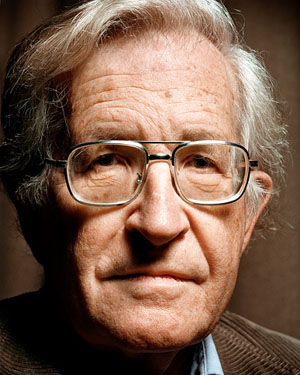
Chomsky inked a column describing his reaction to the news that Osama bin Laden is dead. It's a good example of his sophism.
Chomsky is by training a linguist. When I objected to a particularly egregious and damaging usage of words - the same phrase meant the opposite thing in two cultures, but the same op-ed was intended for both - he replied that it was "all part of The Game." "The Game" - stretching words to their limits so their individual use may be technically correct but their application in context adds up to a falsehood - is what he does for kicks.
He snows people because not everyone grasps (as Chomsky does) that different words can describe the same thing but only apply in particular contexts. By using the word inappropriately he compels the unwary reader to change his or her characterization of an act. For example, he refers to the 1944 Normandy landings as "the U.S. invasion of France". This is technically true, but contextually and emotionally false: France had already been invaded by the Nazis and was under Nazi occupation; furthermore, the French did not consider it a hostile invasion ("hostile" is usually implied when the word "invasion" is employed, but that's a cultural not linguistic truth, get it?) but instead as liberation.
But if you listen to Chomsky and you didn't truly understand events or context you might be convinced that the U.S. was an aggressor in WWII and the Nazis (and French) mere victims. He's recognized as a dishonest academic; that's why he couldn't get a lecture hall when he visited my campus and had to lecture in the coffee shop instead.
Sunday, May 08, 2011
Reactions to the Killing of Osama Bin Laden

“# Saudi Jawa Said: May:02:2011 - 14:13 What an interesting story. Not only in the developing details, but on its impact on the world. Americans are (understandably) celebrating, but the effect on Saudis (and Muslims in general) is curious indeed. Most Saudi and Muslims I’ve talked to seemed kind of shell shocked at the moment. While most of them did not agree with his acts, OBL had become a symbol of the Anti-American Muslim. Its an often used tactic when debating how powerful the US is by saying: “They can’t even find OBL!”. I wouldn’t be surprised to see Che Guivara style postmortem worship cults to arise. Expect to see conspiracy theories breed like rabbits.
# Solomon2 Said: May:02:2011 - 14:31 “Most Saudi and Muslims I’ve talked to seemed kind of shell shocked at the moment. While most of them did not agree with his acts, OBL had become a symbol of the Anti-American Muslim. Its an often used tactic when debating how powerful the US is -” So for “most Saudis and Muslims” OBL represented a never-dying ambition for domination over all others? A goal they feel is suppressed only by the power of non-Muslim nations? And thus these Muslims feel shocked and depressed by the demise of this symbol of their hope, whose tactics they disagreed with but whose publicly-declared goals they shared?”
“Saudi Jawa Said: May:02:2011 - 15:32 ”
“In a word; yes. A lot of Muslims still harbor the fantasy of the “Mulsim Umma” coming back as a super power. To most, the main obstacle in that road is the “Great Devil” AKA the USA. So a lot of them cling to any Anti-US symbol. I mean look at the level of hero worship Saddam got after he was executed. All his evil past deeds were forgotten, and he was elevated to the level of a celestial hero who got his face imprinted on the moon. The moon for chrissakes! A lot of them are hiding their shock under the guise of “speak no ill of the dead”, but it’s not particularly hard to spot.”
“Solomon2 Said: May:02:2011 - 19:27 “A lot of Muslims still harbor the fantasy of the “Mulsim Umma” coming back as a super power. To most, the main obstacle in that road is the “Great Devil” AKA the USA. So a lot of them cling to any Anti-US symbol. I mean look at the level of hero worship Saddam got after he was executed. All his evil past deeds were forgotten, and he was elevated to the level of a celestial hero who got his face imprinted on the moon. ” Jawa, do you agree with the words of one commentator: “Year after year, since 9/11, Osama Bin Laden was at the top of the list of most admired figures in the Islamic world, along with Saddam Hussein and Yasser Arafat, especially in mostly Sunni nations, but even in Shi’ite ones. That’s because he “did it” to America…sure sounds like Bin Laden is an Islamic leader to me. To deny that is simply more Obama Osama politically correct Islamo-pandering. Muslims loved Bin Laden. In a world dominated by conspiracy theories, they wanted it both ways, insisting that the Jews, the CIA, the Bush Administration and the Mossad did 9/11, not Bin Laden; and yet at the same time cheering on and admiring Bin Laden for murdering 3,000 Americans, because they knew he really did it…Osama Bin Laden was not only AN Islamic leader, he was THE Islamic leader.””
“Saudi Jawa Said: May:02:2011 - 23:27 @Solomon2 Hmmm. While I do agree in principal with the comment (where is it from BTW?), I’m not sure about the strength of the feeling he describes in Muslims. While it is true a lot of them admired OBL, I would say very few *loved* him. And I am not sure I would agree with the “THE Muslim leader”. He was definitely influential, and the lack of other strong Islamic figures around its easy to make that assumption. But I think that enough Muslims disagree with the lengths he went to that only a radical few would consider him in that light. An interesting thought exercise is to imagine what would happen if Bin Ladin had restricted his actions to purely non-Muslim targets.”
“Solomon2 Said: May:03:2011 - 13:43 S2: “Muslims loved Bin Laden. In a world dominated by conspiracy theories, they wanted it both ways, insisting that the Jews, the CIA, the Bush Administration and the Mossad did 9/11, not Bin Laden; and yet at the same time cheering on and admiring Bin Laden for murdering 3,000” SJ: While I do agree in principal with the comment (where is it from BTW?), I’m not sure about the strength of the feeling he describes in Muslims. Source: lawyer and movie reviewer Debbie Schlussel.”
Read more about Usama Bin Laden Dead | Crossroads Arabia on:
http://xrdarabia.org/2011/05/02/usama-bin-laden-dead/#comments?utm_source=INK&utm_medium=copy&utm_campaign=share&
The emperors’ clothes
...Some do try and clutch at straws. Maybe they didn’t know. Maybe they’re so daft they didn’t really take this whole business of
pursuing Al Qaeda seriously. Maybe they just didn’t think it was their problem.
But those voices, unconvinced by their own words, quickly trail off … They knew. They knew he was there....
...Why would they do it? What did they hope to gain? Pakistan has nothing in common with Al Qaeda. They serve no purpose to us; there is no confluence of interests that can be imagined.
Did we think we could produce him like a rabbit out of the hat when we needed to? Did we think if we turned him over, the American attention span would lapse and they’d move on, leaving us unable to suckle at the teats of the superpower?
Or, assured in our assumptions about the world around us, did we simply think we could get away with it?
It makes no sense. And yet, perhaps there was an inevitability to this. Did the 1965 war make any sense? It was hard to find any sense to it then, even less so today.
Did Kargil make any sense? Not then, not today.
Did hawking nuclear paraphernalia on the international market make any sense? Buying did perhaps, but selling? And now we
have the world’s most-wanted terrorist recovered from the bosom of the Pakistani security establishment.
So maybe it does make sense after all. The establishment has flirted with irrationality in the past. Now it appears to have
perfected it.
Where do we go from here as a country?
As long as national security and foreign policy remain in the hands of a cabal of generals — unaccountable and untouchable, a
lay unto themselves, and in thrall to their own irrational logic — what future can this country have? Surely, not much of a
future.
Is self-correction an option? Good luck trying to find anyone in the homeland or beyond with even a modicum of knowledge
and understanding of the institution who believes it is capable of reforming itself.
What you will find are retired officers who will tell you what it feels like to be the masters of the universe, part of the inner core
of the establishment. How your feet leave the ground as the world gathers beneath you, bowing and scraping for crumbs
thrown their way. The view from the inside, the inner core, is of limitless power. The view from the outside is of a perch almost
designed to abjure humility and rationality.
What you will find are bureaucrats with decades of experience who ultimately concede that peace with India is unacceptable to the army on any terms. What you will find are diplomats who scoff at the possibility of Musharraf being able to seal a deal on Kashmir with India. Being Numero Uno at home requires having Enemy No 1 across the border.
Zia’s army, Musharraf’s army, Kakar and Karamat’s army — it may seem difficult to reconcile the differences. But while they were very different men, the strategic orientation of the army has more or less been the same. Some addressed the strategic imperatives from a religious angle, others from a more secular angle, but it has always been the army’s angle.
Can anything be done?...
...It is unlikely that Osama was being hosted by Pakistan as a matter of policy. Shielding Afghan Taliban leaders or India-focused militant leaders, however misconceived, is still understandable as part of a warped strategy to promote our defined strategic interests. Hosting Bin Laden or other Al Qaeda leaders isn’t.
Further, the assumption that our military and the ISI must have known of Osama’s presence in Abbottabad is the product of a narrative that projects our national security establishment as extremely capable, effective and omnipresent. This narrative has been conjured up by the national security establishment itself and mercilessly fed to the nation.
The masses buy into it for lack of an alternative narrative and a misplaced sense of nationalism. The political class and the media buy into it because they remain subjects of the ISI’s intrusive gaze, being followed, wiretapped, photographed, interrogated, cajoled and coerced. But hard facts do not back this narrative.Washington Post: In Killing Osama, U.S. had the law on its Side
Dawn: U.S. Intervention: Was it Legal?
...Any statement from the UN welcoming this intervention would strengthen the argument for future interventions. The UN has thus cautiously avoided weakening the norm of ‘non-intervention’, which is one of the most respected principles in international law and politics...Intervention of this nature becomes legitimate only if it is authorised by the UN or a competent regional entity or if it is carried out pursuant to the consent of the state where it has taken place.
Subscribe to:
Posts (Atom)